Power, Water, Air and Resin on a Packaging Line
What has to hold steady in power, cooling water, compressed air and resin condition for a plastic packaging line to stay in specification hour after hour?
Those four services. Watch them as process variables. Hold them before they drift. Keep a contingency the site can describe: who is called, which unit swings in, how long mould temperature and dry resin can hold, and which shots go to quarantine.
A machine list does not carry that story.
Presses, moulds and calibration stickers can all read as current while the pack leaves the window. Quality engineers working through persistent wall-thickness scatter on identical multi-cavity tools set the hydraulic calibration folder aside and overlaid facility SCADA logs on inline vision rejection timestamps. Utility boundary fluctuations preceded the dimensional drift. The press had not announced a fault.
Inline vision systems flag ovality and neck-finish drift within 15 to 45 minutes of an upstream utility boundary excursion, well before machine-level alarms trigger. That gap is why a stable hour of packaging depends on the services around the machine. The cavity can still be filling while the neck is already going oval.
What's Inside
- Power, Water, Air and Resin on a Packaging Line
- Drive Trips, Heater Recovery and the Packs That Miss Seal
- Return Rise, Fouling and How Fast the Part Freezes
- Dew Point at the Drop-Leg
- Residence Time, Pellet Velocity and Upstream Specks
- Hot-Week Cooling and Grid Events on Three Sites
Defect modes that travel with the utilities
Power moves dimensional drift and warp, and it shortens or unsettles the cycle after a trip. Cooling water moves warp, cavity-to-cavity scatter and haze on clear packs. Compressed air moves valve and ejector faults, and it can mark a surface where blow-off air touches the product. Resin condition moves specks and moisture streaks.
None of those modes needs a percentage attached before a walk-through can look for them. They need a trend, a name and a response.
A cross-functional plant audit correlates 30-day continuous utility historian trends directly against batch quarantine logs. The static equipment asset list stays in the drawer for that meeting. On thermoforming and injection-moulding lines run to ISO and BRCGS process requirements, the certificate covers the management system for the packaging process; the historian is what shows whether power, water, air and dry resin actually held during the week a wall-thickness scatter investigation opens.
Historian Before the Folder
Bring the 30-day utility trend to the quarantine log. The asset register will sit there looking complete and still miss the hour the pack left specification.
Drive Trips, Heater Recovery and the Packs That Miss Seal
A 50-millisecond voltage sag drops the extruder VFD while the PLC stays alive on its battery. Melt freezes inside the hot-runner gates. The press screen shows zero machine faults. Teach that signature to the shift. A lit screen and a stopped screw can share the same second.
Voltage sags lasting in practice roughly 20 to 200 milliseconds trip variable-frequency drives on extruder screws and leave main plant lighting and control screens active. Sag, unbalance and harmonic load from a row of variable-speed drives on one bus belong at the drive cabinet and the heater cabinet, read alongside the incoming substation meter. A tidy voltage at the transformer can sit next to a rough waveform at the press.
Restart in the order the plastic actually recovers
Plasticizing stops mid-shot. Heater bands come back unevenly. The first cycles after the drive is reset are the cycles that miss wall and seal targets. Thermal soaking and hot-runner stabilization take customarily near 25 to 40 minutes of purging and cycling before thin-wall seal surfaces hold dimensional tolerance.
That order matters. Purging before the hot runner has soaked only moves cold, partly frozen melt into the scrap bin and then back into the gates. Skipping the soak and shipping the first good-looking shots puts seal faces into the warehouse that will fail a drop the team has not run yet. Log the event as scrap and a timed restart. A single downtime code hides the packs that looked almost right.
Controls, dryers, safety circuits and data logging have to stay up through a grid switch. A generator question is separate: which process loads does it actually feed? Barrel heater bands and the dryer blowers have to be on that list if the backup is meant to protect melt and resin condition. A feed that stops at the PLC rack leaves those loads cold, and the line still faces a full hot-runner purge when the mains return.
Write the fed cabinets on the one-line. A shift supervisor should be able to point at it during a review without calling electrical maintenance first.
Return Rise, Fouling and How Fast the Part Freezes
The mould setpoint on the screen is not the steel temperature. Supply temperature, return rise, flow and fouling in the mould circuits and the heat exchangers decide how fast the part actually freezes.
Mould cooling manifolds need a Reynolds number above 4,000 if heat transfer is going to stay turbulent. On the tool that shows up as a supply-to-return differential held within 1.5°C to 3°C. Wider than that, or flatter because flow has collapsed, and the freeze front moves. Cycle time creeps. Warpage shows next. Dimensional scatter follows. Clear packs lose clarity in the cavities that cooled last.
Clear polypropylene tubs make the pattern obvious from cavity to cavity when the core side loses turbulent flow. Bio-fouling in a secondary circuit will do it while the thermolator still displays the number typed in at the start of the shift. An ultrasonic flow meter and a contact thermocouple on individual manifold return hoses show the starvation a single screen average smooths over.
A bulk return sensor misses a fully plugged parallel core-pin bubbler, because bypass flow through the open channels lowers the combined return reading, so fit a flow sensor on each circuit a single bubbler can block.
A second chiller, and the strainer in front of it
A second chiller counts when the valves let it into the loop during the run. Swing-over that needs a shutdown is a spare in the plant layout, waiting for a planned stop. A strainer packed with debris will starve a healthy machine of flow however new the pump is.
Automated backflush strainers and plate heat exchangers need differential-pressure checks every 14 to 21 days in high-pollen spring months, when restriction builds faster than a winter interval assumes. Put that check on the same board as mould maintenance. A clean press with a fouled exchanger still ships warp.
Dew Point at the Drop-Leg
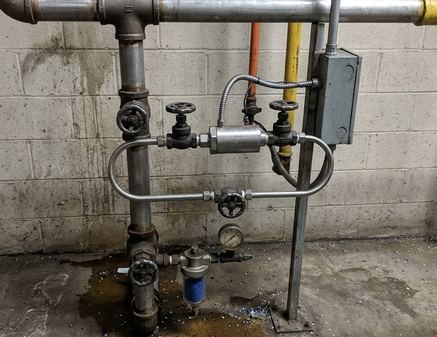
Instrument air and blow-off air do different jobs. Keep the treatment separate. Pneumatic logic, ejectors and any air that can touch a pack need a dry, filtered supply. Air-knife and general blow-off can live on a coarser leg, provided that leg cannot back-feed the valves.
Wet or oily air sticks valve spools, slows ejectors and turns a pressure gauge into a poor witness. On a four-second cycle a hesitating ejector looks like a tooling fault. A portable hygrometer at the press drop-leg has traced that hesitation to a failed zero-loss condensate drain on the main receiver. Moisture at the drop-leg explained the delay. The spool had nothing wrong with it.
Refrigerated and desiccant dryers serving pneumatic logic and part blow-off are held at a pressure dew point between -20°C and -40°C. That band keeps moisture from condensing when air expands fast at the nozzle. Dew point, filtration and condensate drains are the variables worth trending. A class code adds nothing until the site is actually measuring those three.
Bypassing a dryer for a shift belongs on the quality record. The pack sees the moisture. The maintenance note can call the bypass temporary and the surface mark will still be there.
Compressor That Never Unloads
Leak noise in the hall, and a compressor that never unloads, means the system is being sized by waste. Ask for the latest ultrasonic leak survey and the dew-point trend. Those surveys, with point-of-use coalescing filter inspections, run on a 60-to-90-day cycle across packaging-hall drop legs.
The sheet should name the drop legs, the date and the drains that were found failed or passing. A conversation about "the air seems fine" is not that sheet.
Residence Time, Pellet Velocity and Upstream Specks
Material handling is a utility. Dryer dew point, residence time, conveying velocity, blender accuracy and a contaminant check before the hopper decide what the screw actually melts. The mould only shapes what arrives.
Start with the dryer. Hygroscopic resins need a continuous 4 to 6 hours of residence in a mass-flow drying hopper, with the regeneration air loop holding a -40°C dew point. That dew point is the drying-air loop, separate from the compressed-air dew point on the press. Cut residence short and moisture survives into the melt. It shows up as streaks, splay or brittle walls.

Why the dryer comes before the elbow on a walk-through: moisture is already in the pellet when conveying starts. Fixing velocity on a wet lot only delivers dry-looking dust and wet resin to the same hopper. What goes wrong if the order is reversed is a mould trial that chases splay while the hopper clock still reads under the residence the resin needs.
Elbows, then the lid
Dilute-phase vacuum conveying, balanced so pellet velocity stays between 15 and 22 metres per second, limits angel-hair and impact dust at directional elbows. Push past that band and friction heat builds streamers on long-radius aluminium bends. Those streamers shear into virgin resin. Black specks in thin-wall lids then survive a screw-and-barrel teardown, because the mould and the barrel never made them. The bend did.
Blender accuracy and a metal or contaminant check belong before the hopper throat, on the same walk. A magnet or a screen that was pulled for a changeover and not put back will feed the next lot whatever the dryer dew point says.
Lid, Silo, Elbow
On the walk, read residence and dew point on the dryer, then look for streamer at the conveying elbow, then check the silo and the hopper lid. Mixed regrind, a warm silo wall and a hopper left open between shifts are implementation points a quality manager can audit without opening a historian.
Changeover is where those three stack. A warm silo, a blender still holding the last regrind ratio, and a lid parked on a stool will undo a dryer that was inside its dew point an hour earlier.
Hot-Week Cooling and Grid Events on Three Sites
Identical all-electric moulding presses have turned out very different scrap patterns through summer heatwaves and winter grid-load peaks. The difference sat in the utility backup behind the press. Regional supply-chain auditors responded by using one qualification checklist across converter sites in Western and Central Europe, and by asking each site to answer from its own records.
An FMCG engineer on a visit, or in a supplier review, can put the four utilities into questions a plant in Belgium, Poland or Germany should be able to open on a screen.
- What is trended on power, cooling water, compressed air and resin drying, and at what interval?
- Who is called when a trend leaves its band, on days and on nights?
- How long can the process hold mould temperature, dry air and dry resin if the primary unit trips?
- What is on backup, and what simply stops?
Country differences stay questions. The same list applies at each European facility. The answers come from that site's historian, maintenance roster and restart sheet.
Hot week, cold week, 02:00
Cooling capacity has to be shown in a hot week and a cold week. Qualification audits check whether closed-loop adiabatic or chiller systems can hold a 10°C to 14°C water supply when external ambient wet-bulb temperatures peak in July and August. Ask for that summer record beside the winter trial. Grid ride-through is the matching question on power: which drives, heaters and dryers stay up, and which wait for the mains. Maintenance cover is the matching question on people. A trip at 02:00 needs the same call-out path as a trip during a day-shift meeting.
Monitoring, preventive maintenance and contingency sit inside those questions rather than in a separate policy binder. Instrument calibration dates. Exchanger and filter condition, including the 14-to-21-day differential-pressure checks when pollen loads the strainers. Leak surveys on the 60-to-90-day rhythm. A written restart sequence after a utility loss, naming who quarantines the first shots and which test they run.
The know-how a key client can actually use is which variable is trended and who answers the phone. Packaging technologies on the floor, thermoforming or injection-moulding, stay in specification only while those answers match the records.
The hold rack is the scale of a utility trip: restart protocols keep the first 50 to 150 shots in quarantine for destructive seal and drop testing whenever an excursion interrupts continuous cycling.