
Which Lots Could You Name Before the Next Shift?
If a food-contact film were named in a recall tonight, which resin, masterbatch, and finished-pack lots could be isolated before the next shift? Recall readiness requires an unbroken lot genealogy from incoming resin and masterbatch through conversion to the dispatch line, paired with records a team can actually retrieve and a mock recall that reconciles quantity. Scoping happens inside the narrow window between an evening quality hold and the 06:00 shift handover, when day-shift quality clerks and locked physical filing cabinets are inaccessible.
Three operational breaks decide whether a containment action stays narrow or expands to an entire production campaign:
- A broken parent-lot link: Severed genealogy between the parent jumbo roll and slit child reels leaves the converter unable to prove which finished goods carry a suspect extrusion layer.
- A record that exists only on the line: A gravimetric blender log kept on a line-side clipboard instead of the shared file stalls after-hours investigation across facilities, including operations structured like Miko-Hordijk Verpackungen GmbH.
- An unreconciled trace exercise: A trace report that identifies a batch code without reconciling dispatched meterage finds a label, yet fails to confirm how much material went where.
From Resin and Masterbatch to the Reel That Leaves the Winder
Maintaining material custody from the raw polymer silo to the loading bay requires capturing every physical split or combination as an explicit system transaction. Whenever an operator swaps an octabin of slip or antiblock masterbatch mid-run, the enterprise work-order stays static unless the hopper change is logged against the running meterage.
A complete identity chain connects six distinct records in sequence:
- The incoming virgin resin silo or octabin lot.
- The masterbatch or functional additive lot.
- The gravimetric dosing recipe record.
- The extrusion and slitting work-order.
- The individual child reel or pouch lot.
- The SSCC pallet label generated at the winder exit.
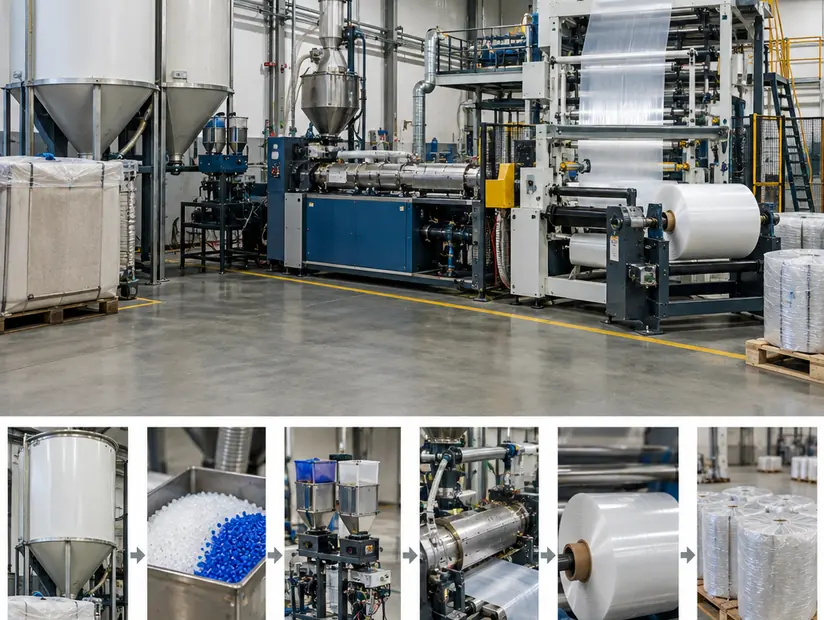
When film is slit, rewound, or blended, the operator must log the linear meterage or splice point where a second parent jumbo roll enters a child reel. Doing so ensures the resulting child reel points backward to every parent lot that entered it. Skipping this step at the winder severing the digital thread means any downstream contaminant alert implicates the entire work-order.
Formal quality frameworks anchor this discipline. Under ISO 9001:2015 and the foundational terminology of ISO 9000, organizations must maintain unique identification where traceability is a requirement and enforce strict control of documented information. However, the standard stops short of prescribing floor-level mechanics. While ISO 9001 mandates documented control, it does not define packaging lot-code syntax, prescribe how splice genealogy is formatted, or set a target duration for recall trace exercises.
The Split Reel, the Mixed Pallet and the Missing Dispatch Line
Routine converting floor workarounds routinely defeat high-level ERP architecture. Consider a hypothetical, composite scenario on a busy slitting deck: a single wide parent jumbo roll is slit across two web widths to fulfill separate customer orders. After fulfilling the primary lanes, a 400-meter to 800-meter tail remains on the core. The operator holds that short length back, later splicing it onto a subsequent slitter-rewinder job to avoid scrap. The resulting pallets are then staged at an external third-party warehouse, where dispatch notes record the sales order number and total pallet count without listing individual reel IDs.
When a resin supplier later flags a defect in that original jumbo roll, five specific floor habits break custody and prevent a clean scope:
- Relabeling without the parent code: Printing replacement core labels for damaged outer wraps without carrying over the parent extrusion code erases the reel's origin.
- Mixed pallets: Consolidating end-of-run reels from separate extrusion campaigns onto mixed pallets under a single master pallet sheet blends clean and suspect lots.
- Unlinked returns: Returning quarantine or customer-rejected reels into free stock under a newly generated goods-in number strips away the prior production history.
- Toll conversion gaps: Sending film to an external toll slitter or perforator that assigns its own internal batch sequence breaks the converter's serial continuity.
- Order-level dispatch notes: Issuing bills of lading that name the customer sales order and gross pallet tally without recording reel-level serials makes it impossible to isolate which consignee received the spliced tail.
Rework Parentage Rule
Capture the parent extrusion lot on rework tickets before the material is rewound onto a child core, never after a customer complaint arrives.
Food-Contact Hazards Do Not Substitute for Lot History
FMCG brand quality managers treat primary packaging as a direct food-contact input within their own hazard analysis. When an audit query or quality escalation arrives from a food packer, the brand manager is asking the converter to prove which delivered lots could carry a declared safety hazard or a specification failure.
Converters frequently confuse design-level hazard analysis with batch-level lot history. Sending a migration dossier and a process flow diagram in response to a delamination or taint complaint only demonstrates that a risk was considered during product development.
A converter's HACCP plan evaluates ongoing process and material hazards: non-intentionally added substances (NIAS) migration, residual solvent odor from printing inks, or brittle knife fragments at the slitter. Lot history performs a completely different task. It identifies the exact production timestamps, splice boundaries, and pallet serials exposed when a resin certificate of analysis or adhesive curing parameter goes out of specification. Knowing the theoretical migration, odor, or foreign-body risk profile does not name the reels already dispatched to a filling line. Furthermore, Codex-aligned HACCP expectations and a customer's bespoke food-contact specification sheet can be much tighter than the converter's own internal plan, and neither document replaces production mass-balance records.
A Mock Recall That Has to Balance Mass, Not Just Find a Code
Selecting a clean, single-lot, full-truckload delivery for a scheduled traceability audit creates a false sense of security. A realistic mock recall targets a complex production lot that includes a split reel alongside held or reworked stock. The exercise must trace backward from the finished pack to the exact virgin resin silos and masterbatch octabins, and forward to every customer dispatch line. Once the lot codes are listed, the team must reconcile total mass in against total mass out.
A bidirectional mass-balance reconciliation requires accounting for every kilogram of polymer that crossed the weigh-scale:
- Total input resin and functional masterbatch weight drawn from silos and hoppers.
- Good dispatched film weight across all customer deliveries.
- Edge-trim, start-up purge, and slitter tear-off scrap.
- Laboratory retain samples and destructive quality-control test strips.
- Rework rolls staged on the converting floor and blocked stock held in quarantine.
Performance in this exercise rests on three qualitative criteria: the elapsed time required to compile an accurate lot list, the completeness of the quantity reconciliation across all scrap and hold categories, and whether both forward and backward directions close without unexplained material gaps. While the BRCGS Packaging Materials scheme mandates a documented product recall and withdrawal procedure verified by a scheduled traceability test, passing an internal audit sample against a single work-order is narrower than executing a live recall across a third-party warehouse the converter does not operate. A brand owner's contractual recall protocol can also demand tighter reporting windows and deeper sub-lot isolation than the certification scheme baseline.
Records That Must Still Be Readable After the Food Is Gone
Archiving extrusion and slitting records against the converter's production week leaves the facility exposed long before the packaged product leaves the grocery shelf. Record retention schedules must span the converter's own warehousing window, the entire shelf life of the packed food product—whether ambient retort pouches, dry pasta films, or deep-freeze laminates—and the post-consumption complaint and recall window defined in the customer quality agreement. A formal legal hold or an extended packed-product life automatically stretches that retention requirement beyond any baseline certification minimum.
Across that entire duration, four specific records must stay completely legible and cross-referenced:
- Physical lot codes printed inside cardboard cores and on outer pallet labels.
- The documentary link tying the incoming resin Certificate of Analysis to the extrusion work-order.
- The splice and rework parentage log.
- The dispatch line item naming the customer destination and exact shipped quantity.
Physical and digital storage media degrade through distinct failure modes. Direct-thermal pallet labels fade in warm warehouses and paper job travelers become oil-stained or misfiled on the shop floor, while ERP databases can overwrite historical bill-of-material versions during routine system updates. Because paper travelers and electronic tables diverge over time, the quality management procedure must explicitly designate which single copy serves as the authoritative record during a recall.
The Record That Decides the Scope of a Recall
When a live escalation hits the quality desk, the containment boundary is fixed entirely by the genealogy table, the rework note, and the reel-level dispatch file already captured in the system. A converting team cannot retroactively construct a splice log or walk a customer's warehouse to read core labels that have already been run through a form-fill-seal line; the recall will rely strictly on the records held right now, rather than a revised procedure still being drafted.
If a brand quality manager called in the next hour, which missing record — the resin lot, the rework note, or the dispatch line — would stop you naming every pack that has to come back?