What the Cup-and-Lid Trial Had to Establish
A cup-and-lid seal validation trial is the pre-launch check that the heat seal between a new plastic cup flange and its lidding film holds under the filling, handling and storage conditions the pack will actually encounter. For this cup-and-lid pair, readiness rested on three evidence streams together: seal-strength results, filled-cup leak tests and filling-line observations. Launch waited until the customer and manufacturer had closed the gaps left by the first trial.
The immediate challenge was deciding what the available evidence could support. Benchtop peel readings described the mechanical bond around the flange. They did not establish containment with product in the cup or explain how the format behaved during active filling. Clearing the pack required those questions to be examined together.
The technical team therefore kept the pre-launch hold in place while it reviewed the three streams. That decision gave the trial a clear purpose: establish agreement between the bond measurement, the filled pack and the operating line before commercial release.
This distinction matters when interpreting trial results. A completed test sheet can contain useful measurements while leaving an operating condition unverified. Here, the first review exposed missing coverage, and a targeted repeat run supplied the checks needed for release.
What Circumferential Peel Readings Could Settle
Seal strength is the force needed to peel the lidding film from the cup flange. Measured under comparable conditions, it provides a way to examine how the bond responds to sealing-head temperature, dwell duration and contact pressure. These variables define the workable sealing window for the combination being tested.
The useful comparison begins with controlled sealing conditions and continues around the flange. A reading taken only at the pull-tab position leaves the rest of the perimeter undescribed. In this trial, engineers checked multiple circumferential positions to assess whether the mechanical bond remained consistent around the cup.
That order matters. Establishing the dry-flange bond response first separates mechanical consistency from the product conditions introduced later. Without that separation, a change in peel behaviour becomes harder to interpret: the review cannot readily distinguish a difference in sealing conditions from a difference in flange condition.
The peel stream could establish a workable window and circumferential consistency. Its scope stopped short of proving that product, headspace conditions or subsequent line handling would leave containment intact. Those questions belonged to the filled-cup checks.
Every reading also remained specific to this cup resin and lidding film under the trial conditions. It could not qualify another resin, film, lacquer weight or filling line. For packs that rely on a matched flange-to-film interface, transferring the setting without repeating the relevant checks would transfer an assumption rather than evidence.
Where the First Trial Left Containment Unverified
Leak checks examine whether a product or air path exists through the sealed flange after filling and sealing. They sit beside peel measurements because they ask a different question: can the completed pack retain its contents under the conditions being assessed?

A dry-flange peel test and a filled-cup leak check expose different parts of the problem. The former isolates the mechanical bond. The latter introduces actual product fill temperature, the possibility of product splash on the sealing area and the handling the cup receives after sealing. Distribution-relevant stress belongs in the containment assessment as well, where it forms part of the pack's intended exposure.
The first-trial review found that clean, dry-flange peel results had left product-wetted flange performance and thermal stress unverified. Coverage was also incomplete between initial bench qualification and the conditions of an active filling run. These were gaps in the evidence; the record does not identify a particular leak mode or quantify a failure rate.
Dry-Flange Blind Spot
A complete set of peel readings can coexist with an incomplete containment assessment. Check whether actual fill temperature, product exposure at the flange and post-seal handling have each been represented before accepting the leak evidence.
The practical consequence was a continued launch hold. The missing conditions had to be checked before the customer and manufacturer could treat the seal-strength results as part of a complete release decision. A strong peel reading could not close a question that the peel test had never examined.
What Active Filling Revealed About the Seal Window
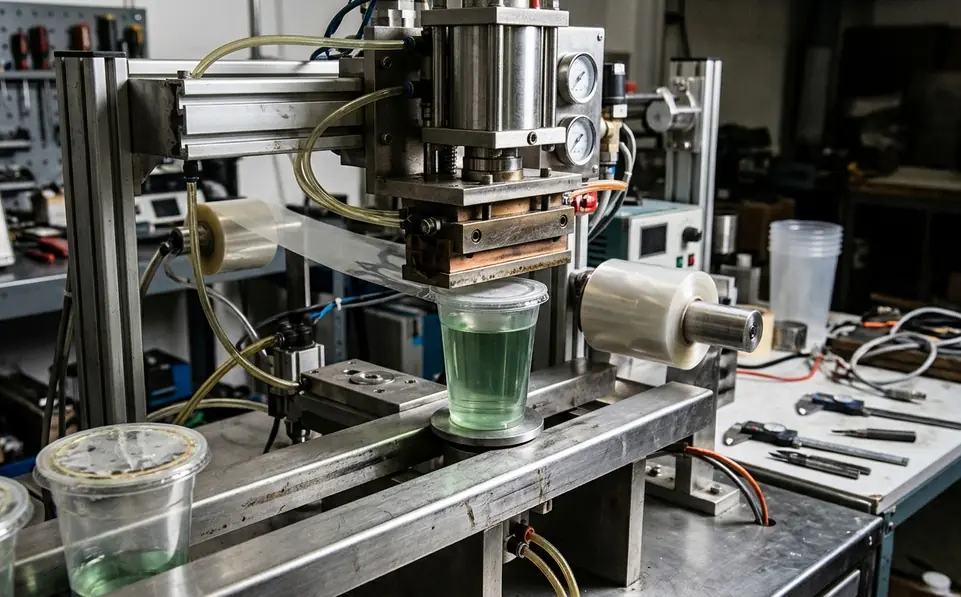
Moving qualification from static bench sealing to active filling changes what must be observed. The bench window remains useful, but continuous indexing introduces the actual presentation of the cup and lid to the sealing head. Temperature, dwell and contact conditions must be understood in that operating context.
The trial's line-side notes covered four physical checkpoints: lidding-film feed alignment, flange dryness before sealing, seal-head co-planarity and the stability of the filled cup as it left the indexing pocket. Together, these observations connected the measured bond to the machinery producing it.
Lid feed established how the film arrived at the cup. Flange observations established the condition of the sealing surface immediately before contact. Head alignment described whether the contact geometry remained even, while exit observations followed the sealed cup into its next handling stage. Recording these points during active filling gave the review context that a detached peel sample could not supply.
A bench window can therefore shift when dwell, temperature or cup presentation differs on the line. The adaptation is to record the operating conditions alongside the samples and interpret them together. Otherwise, apparently comparable peel readings may represent different sealing circumstances.
These notes concerned this customer's filling line and this format tooling only. They were neither a plant audit nor evidence about other FMCG lines or European facilities. Keeping that boundary explicit preserves the usefulness of the observations without expanding them into an unsupported production claim.
How the Joint Review Cleared the Missing Checks
The customer and manufacturer resolved the incomplete coverage by placing the three evidence streams side by side. They compared what the peel results established, what the filled-cup checks covered and what the line observations recorded. This exposed the filled-cup and line-speed conditions still awaiting verification.
The manufacturer supplied the cup-and-lidding combination and the technical interpretation of the seal. The customer controlled the filling-line parameters and retained ownership of the commercial launch decision. That division kept material diagnostics connected to the people responsible for the actual operating conditions.
The parties then repeated the missing work in a targeted verification run before release. The supported outcome is specific: commercial launch waited until the omitted checks had been completed and the evidence streams agreed. The record does not require an invented equipment adjustment or material redesign to explain that resolution.
Release Evidence Aligned
The repeat run closed identified coverage gaps. Its value lay in completing the evidence needed for this cup-and-lid pair under the customer's line conditions.
This is a useful boundary when quality and certification come up: the release decision described here rests on the trial evidence and assigned responsibilities. No certification claim is needed to explain how the customer and manufacturer reached it.
A Six-Step Release Gate for the Next Cup-and-Lid Pair
Consider the next qualification: a quality manager receives a new cup-and-film combination for a filling-line trial. The following worked sequence creates a release record that follows the pack from specification through sealing and containment to the launch decision.
- Confirm the flange and film specification. Identify the cup resin, flange specification and lidding film being qualified. Keep that pairing attached to the trial record so subsequent readings remain traceable to the materials actually sealed.
- Establish the seal window on the line. Record sealing-head temperature, dwell and contact pressure for the selected operating window. Associate the samples with those conditions; an unexplained setting change leaves the comparison incomplete.
- Take peel samples around the flange. Compare the bond at multiple circumferential positions. Consistent peel around the flange supports progression. Uneven behaviour leaves the seal-strength gate open and requires further checking before release.
- Check filled cups for leak paths at process temperature. Include the product-temperature, flange-exposure and handling conditions selected for qualification. A detected leak path prevents clearance; an untested condition remains unfinished work.
- Observe a defined filling run. Set the observation period in the trial plan, then record lid-feed alignment, pre-seal flange condition, head contact and cup stability leaving the sealer. Stable lid placement onto clean flanges supplies the line-side evidence needed alongside the samples.
- Reconcile the three streams before launch. Place the circumferential peel record, filled-cup leak findings and line notes together. Release requires consistent peel, no leak path in the filled samples and stable lid feed with a clean flange. Hold launch whenever a stream disagrees or a planned check remains incomplete.
Test While Filled
Schedule the leak check while filled cups are at process temperature. Empty bench seals alone leave that operating condition unexamined.
For this next pair, the manager can finish the release entry with three explicit findings: circumferential peel is consistent, process-temperature filled samples show no leak path, and the defined run records stable lid placement onto clean flanges. The manufacturer supplies the seal interpretation; the customer matches it to the recorded line conditions and signs the launch decision only after all three entries agree.