Beyond the PDF: The Reality of Food-Contact Declarations
Placing plastic food-contact materials on the EU market requires strict adherence to Regulation (EU) No 10/2011 compliance mandates. Every batch must arrive at the filling facility with a written declaration of compliance. The DoC functions as a required accompanying document, not standalone proof that a pack remains safe under a brand’s actual filling, sealing, and shelf-life conditions. Relying solely on the top-level declaration exposes food manufacturers to significant regulatory and safety gaps.
The actual safety of the packaging depends on how closely the supplier's test assumptions match the reality of the factory floor. Quality teams need four specific files behind that initial PDF to verify safety. These include use-matched migration reports, a detailed change-control history, lot-to-lot traceability records, and a risk-based verification plan. Securing these underlying documents turns a passive paperwork exercise into an active quality control gateway.
Scrutinizing Annex IV Particulars for Hidden Gaps
A plastics DoC carries specific Annex IV particulars that demand line-by-line review. The document must clearly state operator identity, material identity, dual-use additives, relevant restrictions, and precise specifications for use. FMCG scrutiny frequently exposes gaps in food-type coverage, time and temperature limits, and surface-to-volume assumptions that fail to match the actual physical pack.
Missing details serve as an immediate trigger to request supporting evidence. Generic phrases like "suitable for all foods" require intense skepticism from procurement and quality departments. Clearance requires exact alignment between the stated parameters and the physical packaging format.
Annex IV Surface-to-Volume Mismatches
A supplier might test a flat film using a standard surface-to-volume ratio. Thermoforming that same film into a deep tray changes the contact dynamics, requiring new calculations to ensure compliance.
Quality managers must cross-reference the Annex IV particulars against the specific SKU's thermal process and expected shelf life. Dual-use additives require special attention because they function as both plastic additives and food additives. Their presence in the packaging material can inadvertently alter the composition of the food product itself, triggering separate food safety regulations.
Aligning Migration Data With Actual Shelf Life
Overall and specific migration testing provides assurance only when the simulants, contact time, temperature, and surface-to-volume ratios reflect the real manufacturing process. Relying on a convenient worst-case scenario that never occurs in production leaves blind spots. Testing a mild case similarly under-tests hot-fill applications or long chilled storage.
Quality managers must require the underlying test reports that sit behind the DoC. These files detail the exact method, the simulant set used, detection limits, and which restricted substances were actually measured. Simulant exposure times ranging from 2 to 24 hours at 40 °C to 100 °C hinge on the specified thermal process.
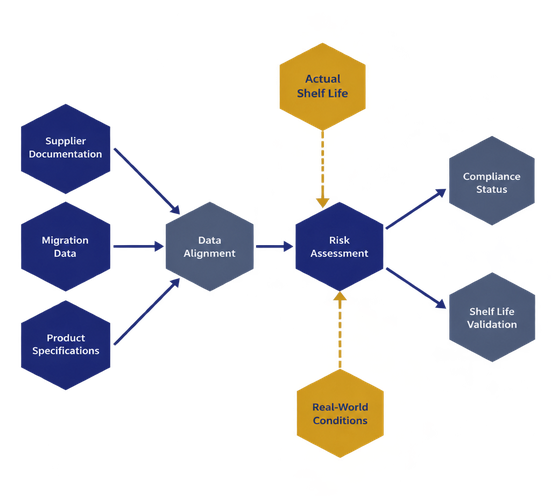
Migration Envelope Invalidation
Migration test results cover the stated conditions of use exclusively; introducing a new fat content, a retort step, or extending the best-before date places the packaging outside that tested envelope until a new simulant study is completed.
A packaging format validated for a 30-day chilled shelf life requires new migration data before it can be used for a 90-day ambient product. The test data must bound the physical reality of the product's lifecycle.
How Formulation and Process Shifts Invalidate Existing Paperwork
A signed DoC becomes obsolete the moment a physical manufacturing parameter shifts. Resin or masterbatch swaps, recycled-content adjustments, new adhesives, different inks, extrusion-line moves, or shifting production to a different converting site all require immediate documentation updates. Different extrusion machinery can impart varying thermal stress on the polymer, altering its migration profile even if the chemical formulation remains identical.
Quality teams initially considered accepting annual supplier letters re-certifying existing DoCs, but discarded this approach because it masked unrecorded masterbatch swaps. They instead mandated a change-control log extract tied to a frozen bill of materials.
Procurement must ask for this change-control log detailing resin swaps or extrusion-line moves in practice, roughly a 30- to 90-day window prior to delivery. An undated or annually recycled PDF lacking a revision history represents a fundamental control failure. Maintaining a frozen bill of materials ensures that the physical packaging delivered in December matches the exact chemical profile of the packaging tested in January.
Tracing the Polymer Lot to the Finished Tray
Robust verification demands a clear chain from the raw material to the finished packaging. Quality teams must walk this path: starting with a 10-digit polymer lot code, moving through the masterbatch, identifying the film or tray lot, tracking the converting order, and finally logging the inbound pack lot at the filler.
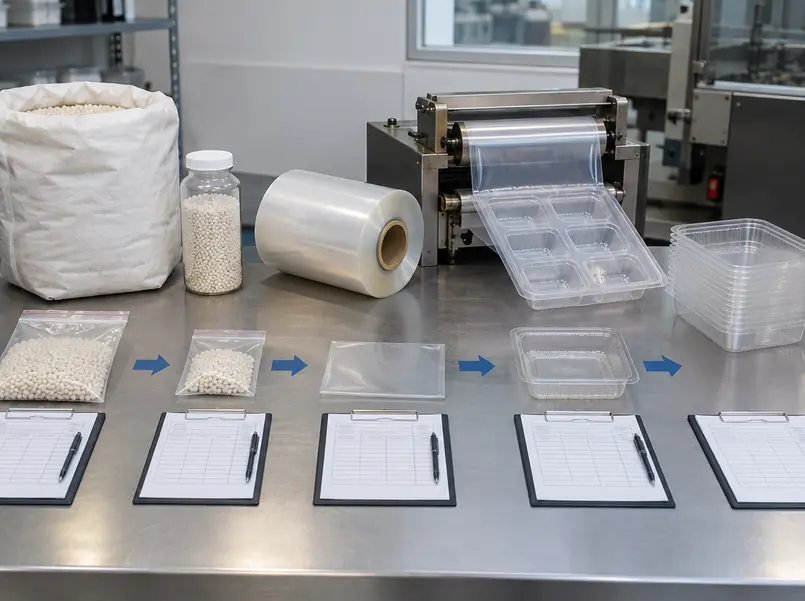
One-up, one-down traceability linking that 10-digit polymer lot code to the final converting order provides the necessary structural proof. Facilities require certificates of analysis that share exact lot codes with the DoC’s supporting migration file. Generic grade certificates offer insufficient protection against contamination or formulation errors.
Incoming checks bind the paper trail to the physical goods through visual lot-code matches and retained film or tray samples. A strict hold rule applies immediately when inbound codes fail to reconcile with the approved documentation. Miko-Hordijk Verpackungen GmbH maintains ISO 9001 and ISO 9000 standards across its extrusion lines. Beyond the converting site, traceability outcomes depend on the filler keeping lot records unbroken.
Structuring Risk-Based Checks Beyond the Supplier PDF
A practical verification ladder starts with document completeness. The next step involves targeted independent migration testing on high-risk SKUs involving fatty foods or hot-fill processes exceeding 70 °C. Multilayer structures with functional barriers and long shelf-life products also require this secondary validation.
That targeted testing supplies the validation the supplier paperwork alone cannot. Periodic supplier process audits form the final tier of this verification strategy.
Effective audits expose gaps by asking specific questions. Auditors must determine exactly which restricted substances were tested, what physical parameters changed since the last DoC issuance, and which specific converting site manufactured the current lot. Frequency remains qualitative and scales directly with the complexity of the packaging structure and the severity of the filling environment.
Executing a PE/EVOH/PE Film Check for Chilled Yoghurt
The following sequence demonstrates a complete verification for 500 g yoghurt packaged in a PE/EVOH/PE lid-stock film. The product is filled at or below 8 °C and stored at 4 °C for 28 days, involving both aqueous and fatty contact with no hot-fill step.
- Verify the Structural Identity: Read the DoC specifically for food-type, time and temperature parameters, and multilayer identity. Reject the document immediately if it relies on generic "all foods" terminology or omits the EVOH and tie layers from the structural description.
- Audit the Simulant Selection: Request the overall and specific migration reports. Verify that the testing used simulants covering both aqueous and fatty yoghurt.
- Confirm the Thermal Envelope: Confirm that the testing times and temperatures successfully bound the 28 days at 4 °C plus the initial filling conditions.
- Calculate the Physical Ratio: Calculate the surface-to-volume ratio in the test report to ensure it matches the exact dimensions of the 500 g pack.