What Actually Qualifies a Second European Packaging Plant
A food-contact tray made at a second address carries a concrete legal consequence. Under Regulation (EU) No 10/2011, the manufacturing site address is tied to the compliance file supporting the plastic article. Moving an approved resin recipe and mould to another factory therefore creates a fresh compliance event.
The alternate plant becomes shippable when five gates are closed: the document pack is complete, the first trial is frozen, measurements correlate with the incumbent plant, the food-contact file names the new address, and transport has been qualified from the new ship-from point.
Ownership should be settled before line time enters the schedule. The process or packaging engineer owns the document pack and trial. Quality owns measurement correlation and the food-contact file. Quality and supply chain share the transport protocol and customer approval file. Where the alternate address sits under Miko-Hordijk Verpackungen GmbH, the German subsidiary must still appear in the records relevant to that qualification cycle; group affiliation does not replace site identification.
Five Release Gates
- Document pack: specification, drawings, cavity map and approved material list are locked.
- Trial freeze: the alternate line runs an agreed, recorded recipe.
- Measurement correlation: both sites produce comparable results.
- Food-contact file: the Declaration of Compliance identifies the manufacturing address.
- Dispatch approval: the actual unit load and new transport origin are qualified.
Scope here stops at European FMCG plastic packaging; retailer audit approval remains separate.
Close the Document Pack Before Resin Reaches the Hopper
The document freeze comes first because every later comparison depends on a stable definition of the pack. Current specifications and drawings must be issued alongside the approved resin and masterbatch list, colour standard, cavity map and incumbent control plan. The second site needs the same acceptance language used at the first site, including defect classifications and measurement locations.
Lock the cavity map, colour standard and resin-masterbatch list, per usual scope 14 to 21 days before scheduling the alternate line. That interval gives engineering and quality time to resolve obsolete drawing revisions, substitute colour references or resin codes that exist only in a local purchasing system. Releasing those questions onto the production floor turns machine time into document review.
Write the Agreement for Two Addresses
The quality agreement should name both manufacturing locations in its change-control provisions. A site addendum deserves a line-by-line review against the equipment, responsibilities and release route at the alternate factory. Copying the incumbent file silently can preserve the wrong test method, escalation contact or batch-release authority.
An ISO 9001 document hierarchy helps control revisions, while ISO 9000 terminology can keep approval, verification and validation distinct. Neither convention decides whether the specific packaging article is legally supported at its new manufacturing address.
Hopper Hold Point
Bring the incumbent Declaration of Compliance and migration support into the review as technical history to rebuild. Treating that declaration as a transferable certificate leaves the new address outside the evidence chain.
Freeze the First Trial Around One Recorded Recipe
The first alternate-site run needs a recipe that can survive scrutiny after the line has stopped. Record the resin grade, masterbatch, agreed regrind ratio, drying conditions, melt temperature, tool temperature, cycle time and tool or insert identity. If one of those variables changes without an authorised trial instruction, the resulting pieces no longer support a direct plant comparison.
Separate Fit From Process Stability
A first-article run answers a narrow question: can each relevant cavity hold the drawing under the frozen setup? It establishes dimensions, appearance and basic functional fit at a defined moment.
The capability run asks whether the operating window can remain stable over production time. For this qualification sequence, it requires a continuous 4 to 6 hour shift without unlocking tool temperatures, melt temperatures or cycle times. Operators may make the normal observations required by the control plan, but an undocumented recipe adjustment breaks the evidential continuity of the run.
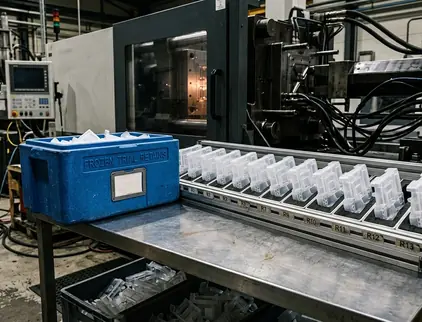
Retains should be nested by cavity, hour and pallet. That order matters. A later leak, flange discrepancy or colour query can then be traced to a physical pack and its production position rather than reconstructed from shift memory.
Retain Chain
Mark the outer retain bag and the individual stack. Pallet identity alone cannot separate a cavity effect from a time-dependent drift across the shift.
Make Both Plants Speak the Same Measurement Language
Use the same characteristic, method, units and conditioning protocol at both sites. Where gauge models differ, correlate the gauges before judging the processes behind them.
The reason is visible in a thermoformed tray investigation. Quality teams compared flange measurements from the incumbent and alternate plants and found a consistent variance of roughly 0.15 mm. The forming process initially appeared to be the source. Review of the test sequence showed that the alternate site conditioned samples at 45% relative humidity for 12 hours, while the incumbent used a 24-hour ambient protocol. Once conditioning became part of the controlled method, the plant comparison had a defensible basis.
Correlate the Features That Release the Pack
- Pack weight, using an agreed balance resolution and tare convention.
- Critical wall and flange dimensions at drawing-defined locations.
- Leak or seal integrity under the specified fixture and loading method.
- Coefficient of friction with matched surface orientation and conditioning.
- Visual defects under the same lighting, background and defect catalogue.
- Barrier performance where the customer specification already requires it.
Both sites should be judged against the specification window. The incumbent plant may operate close to one edge and produce a familiar-looking average; that average is a process position, not a second acceptance specification. An alternate site can occupy another part of the valid window while still meeting drawing and functional requirements.
Conditioning Trap
Place conditioning duration and environment on the result sheet itself. A method stored elsewhere is easily missed when sites exchange spreadsheets.
Rebuild the Food-Contact File for the New Address
The Declaration of Compliance must identify the actual manufacturing address. An unchanged polymer formulation does not remove that requirement when production moves to a second European plant.
The supporting stack starts with the composition and intended-use assumptions for the plastic article. Overall and specific migration coverage should match the designated food simulants and relevant contact conditions. For the new site, standard specific migration limit testing uses a 10-day exposure at 40°C with those simulants. The file should connect the tested construction to the resin, masterbatch, layer structure and process represented by the alternate line.
Follow Process Differences Into the Evidence
NIAS review requires attention where the formulation or manufacturing process creates a plausible difference. Regrind practice, residence time, drying and thermal history belong in that assessment because the same nominal resin can experience a different process path.
The new line also needs a GMP process description under the European rules for food-contact materials. It should identify material control, contamination prevention, traceability, process monitoring and release responsibilities at that address. This is where the frozen trial record becomes more than an engineering note: it anchors the compliance narrative to an observed manufacturing condition.
Validate the Route From the New Ship-From Point
A cavity can remain identical while the distribution environment changes around it. The second origin introduces its own vibration profile, dwell periods, climate exposure and handling sequence.
Distribution validation therefore uses the unit load the customer will receive: production pallet, actual pallet pattern, stretch-wrap or strap recipe, layer pads and any approved mixed-SKU stack. A bench test on one empty pack cannot reveal column movement, flange abrasion or load relaxation across a wrapped pallet.
Run the Load Through the Filler’s Handling Points
The protocol requires a physical transit loop, customarily near 400 to 650 kilometres. It should include the actual dock levellers and clamp-truck handling at the filler’s inbound warehouse. Seasonal transport legs deserve representation where temperature or dwell can alter stack stiffness, wrap tension or pack shape.
- Build and document the unit load at the alternate plant.
- Record wrap or strap settings and the pallet configuration.
- Complete the defined road loop from the new origin.
- Pass through the filler’s normal unloading and internal handling route.
- Inspect load stability, pack damage and functional features before release.
This order preserves the connection between the shipped configuration and the condition inspected at receipt. Repacking midway erases part of the route being qualified.
Build the Customer File That Creates an Approved Source
Customer approval rests on fileable artefacts rather than the converter’s statement that the trial ran well. The specification amendment should list both site codes. Golden samples from the alternate line should be retained by the converter and the brand under an agreed identification and replacement rule.
The first delivery is typically restricted to 2 to 4 pallets, allowing intensive inbound inspection before full dual-sourcing begins. Its inspection plan should name the checks, sampling points, disposition authority and communication route for any hold.
Route Mixed-Stock Complaints Before Dispatch
Once packs from two sources enter the same filling network, a report described only as “packaging leak” or “colour drift” loses crucial resolution. Pallet, batch and site codes must survive through receipt, line feeding and complaint capture. The routing instruction should tell customer service and quality which code to request and which plant receives the investigation.
Purchasing can coordinate commercial release, but technical source approval belongs with the customer quality manager and, often, the filling-site quality lead. Their signatures connect the alternate source to the specification amendment, first-delivery plan and retained samples.
Dual-Site File
Release the source only when the customer can identify which plant made a questioned pack without opening an internal forensic exercise.
05:12 on the First Dual-Source Dispatch
At 05:12, the night-shift quality lead stands at a stainless bench in the second plant’s converting hall. Two seal-strength traces from 15-millimetre test strips lie side by side: one from the incumbent line, one from the alternate. Beyond the bench, the first dual-source pallet is already stretch-wrapped for the 06:00 collection.
The lead checks the site code against the named-address Declaration of Compliance, follows the retain reference back to the frozen run and turns to the correlated test record. On the transport sheet sit the completed new-origin loop and inbound handling checks.
Initials go onto the certificate of analysis. A pallet truck enters the aisle, lifts the approved load and rolls it towards the waiting bay door.