From vacuum dairy pots to high-speed plug-assist cups
Thick vacuum-formed dairy pots could carry extra material through the wall. That surplus masked uneven draw: a heavy base and a thin sidewall might still leave a usable pot. Thin PS, PET and PP cups offer much less room for that imbalance, especially when the same forming cycle must produce a rolled rim for a foil or lid seal.
The turning point came when cups had to stack, denest and seal at FMCG line speed. Wall thickness then affected more than cup strength. It influenced cooling and shrinkage, which changed cup height and stack behaviour. The rim had to retain enough material to roll consistently while presenting a level seal path. A cup that looks sound on its own can still jam a denester or present an uneven land to the sealing head.
Four variables govern repeatability in this setting: the sheet temperature window, plug-assist geometry and timing, incoming sheet quality, and tooling condition. They interact, but each has a distinct diagnostic signature. Keeping those signatures separate prevents an oven adjustment from concealing a gauge band or a worn rim-former.
The control hierarchy here concerns round and slightly tapered dairy and dessert cups. Their deep draw and rolled rim make wall distribution and seal geometry inseparable; shallow trays and blister packs call for a different assessment.
The sheet temperature window sets wall distribution
The sheet reaches the forming station with a thermal history, rather than a single useful temperature. Multi-zone oven settings, residence time and web sag determine how readily material moves when the plug enters. A reasonably uniform membrane stretches into the cavity in a controlled sequence. A hot centre bordered by colder material draws differently: the centre moves early, while the edge resists and may leave too little workable stock near the rim.
Sag is a useful process observation because it reflects the web’s response across its unsupported span. It cannot, by itself, prove that the rim is ready to form. Plug-entry temperature and the distribution of heat across the web matter alongside it. The order of diagnosis matters: establish whether the incoming sheet is both thermally consistent and of consistent gauge, then adjust the oven map. Otherwise, heating can relocate a thin region without correcting its material deficit.
Why polypropylene leaves less room to chase heat
Amorphous PS and PET sheet generally gives a more forgiving response to forming heat than semi-crystalline PP. In PP, a small thermal shift can change draw behaviour sharply. Underheated material resists the cavity detail, encouraging webbing or incomplete rim fill. Overheated material can run rapidly into the base and leave a weak sidewall. A setting that improves one feature may damage another within the same cup.
A cold rim can tempt operators to raise the outer oven zones. That single-zone chase has an important limit: heat changes where available material flows; it cannot add stock to a thin gauge band. When rim fill improves only as another part of the cup thins, inspect the incoming sheet profile before accepting the new oven setting.
Cold-Rim Check: Compare web sag, plug-entry heat and cross-web gauge before changing an outer zone. The same visible rim defect can begin in the oven or on the sheet roll.
Plug shape and entry timing divide the draw
Plug assist establishes much of the material distribution before vacuum or pressure finishes the cup. Its nose shape and side profile determine where contact begins and how material is carried towards the base. Stroke and entry delay determine when that contact occurs relative to sheet softening and cavity evacuation. Surface temperature affects both heat loss at contact and the ease with which the polymer slips over the plug.
A cold or sticky plug can arrest material at the wrong point, leaving excess stock at the base and thin sidewalls. An aggressive or early stroke can force material into corners before the rest of the web has begun to share the draw. The rim then receives less stock even when the base thickness appears acceptable. For a cup with a rolled lip, that loss can continue downstream as an inconsistent rim-land.
Plug material is therefore a heat-transfer and slip decision. Syntactic foam limits heat extraction from the sheet and can provide a controlled contact surface. Heated aluminium offers a different thermal response and requires deliberate surface-temperature control. A PTFE-coated surface changes slip and release. None of these choices works independently of plug geometry: a low-friction surface on the wrong nose profile can still send material to the wrong part of the cavity.
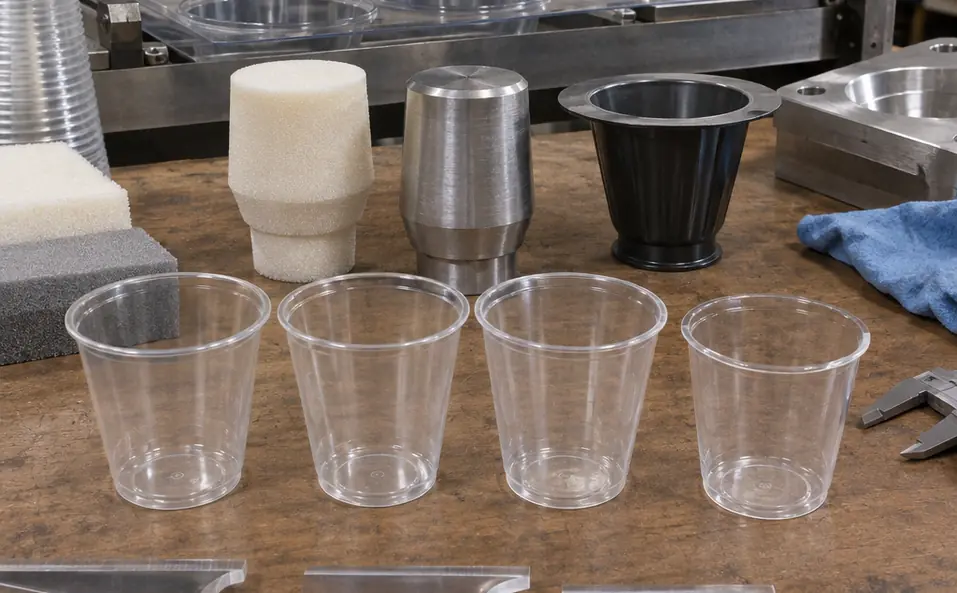
A useful plug trial holds the sheet condition steady and changes one contact variable at a time. Examine the base, sidewall and corner together, then check whether the rim retains a continuous forming allowance. If the wall improves while rim stock disappears, the apparent gain has merely moved the weak point.
Incoming sheet carries gauge bands into the cup
A machine-direction gauge band follows the web into successive cavities. As the plug stretches that band, it can become a recurring sidewall thickness band. Thermoforming redistributes sheet; it does not average a persistent incoming variation into a uniform cup. That distinction matters when wall scatter repeats in the same region across otherwise stable cycles.
Start an incoming-sheet investigation with a gauge profile across the web, then compare the profile with the location of thin walls in formed cups. Orientation deserves a separate check. Material with uneven residual orientation can shrink differently as it heats and cools, shifting cup height or changing how the rim rolls down. Roll temperature also affects the condition in which sheet enters the oven. Two rolls with similar nominal gauge may therefore respond differently under an unchanged recipe.
What regrind and moisture reveal downstream
Regrind fraction, contamination and moisture change repeatability in ways that a single thickness reading will miss. Contamination may appear as local holes or visible defects; an unstable material blend can contribute to haze or brittle rims. PET moisture calls for particular attention because material condition can deteriorate during heating and leave a cup that forms but handles poorly at the rim.
The practical release question is whether a roll holds its gauge and forming response through the intended run. If a new roll brings back a sidewall band, cup-height drift or rim brittleness, preserve the last stable forming settings while the sheet is checked. Oven changes made against unstable incoming material make the eventual root cause harder to identify.
Mould heat, vents and rim wear change the finished cup
Cavity temperature belongs on the process sheet alongside oven and plug settings. Cooling-channel condition controls how consistently each cavity removes heat; uneven cooling changes shrinkage and release even when the incoming web is stable. Cup height and stack behaviour can drift cavity by cavity before a conspicuous wall defect appears.
Vents deserve the same routine attention. Blocked or polished-over evacuation paths prevent air from leaving the corner cleanly. The result can resemble a sheet-heat problem: incomplete corners, chill marks or a local thin area. Before raising oven heat to fill that corner, compare cavities and inspect the vent path. A defect tied to one cavity points towards tooling condition more strongly than a defect shared across the web.
The cup still passes through rim-formers, cutters and stacker guides after it leaves the cavity. Wear at any of these contacts can alter rim-land width, distort the seal path or increase stack-height scatter. A cutter can leave an uneven edge on a cup whose formed wall is otherwise consistent; a worn guide can change denesting force by damaging or displacing the rim during stacking.
That makes tooling inspection part of a cup-consistency trial, rather than maintenance performed only after rejects rise. Record cavity-specific marks, rim shape and stack behaviour before changing heat. The observed pattern will usually narrow the search faster than another adjustment to a shared oven zone.
Lock plug assist and sheet heat before revising oven zones
Set the incoming sheet temperature window and the plug-assist geometry, entry delay and surface temperature as one forming condition. Once that combination produces balanced draw and a sound rim, hold it while evaluating rolls and tooling. Treat gauge profile and orientation as sheet-release gates; treat cavity cooling, vents, rim-formers, cutters and guides as tooling-release gates.
A trial judged only by base thickness can approve the wrong cup. Quality managers should compare the rim-land, seal-path geometry, stack height and denesting behaviour alongside wall distribution. Those observations test what the cup must do on the filling line, where a small rim or stacking change can matter more than a reassuring reading at the base.
Freeze plug assist and the sheet heat window first, then reject sheet or tooling that cannot hold the required rim and stack geometry. Rewriting oven zones to compensate for that scatter only makes the next stable run harder to reproduce.